Anthropic's Claude Beats Human AI Safety Researchers
Anthropic has demonstrated that its Claude models can autonomously discover and implement training methods to fix AI alignment failures, outperforming human experts at a fraction of the cost.
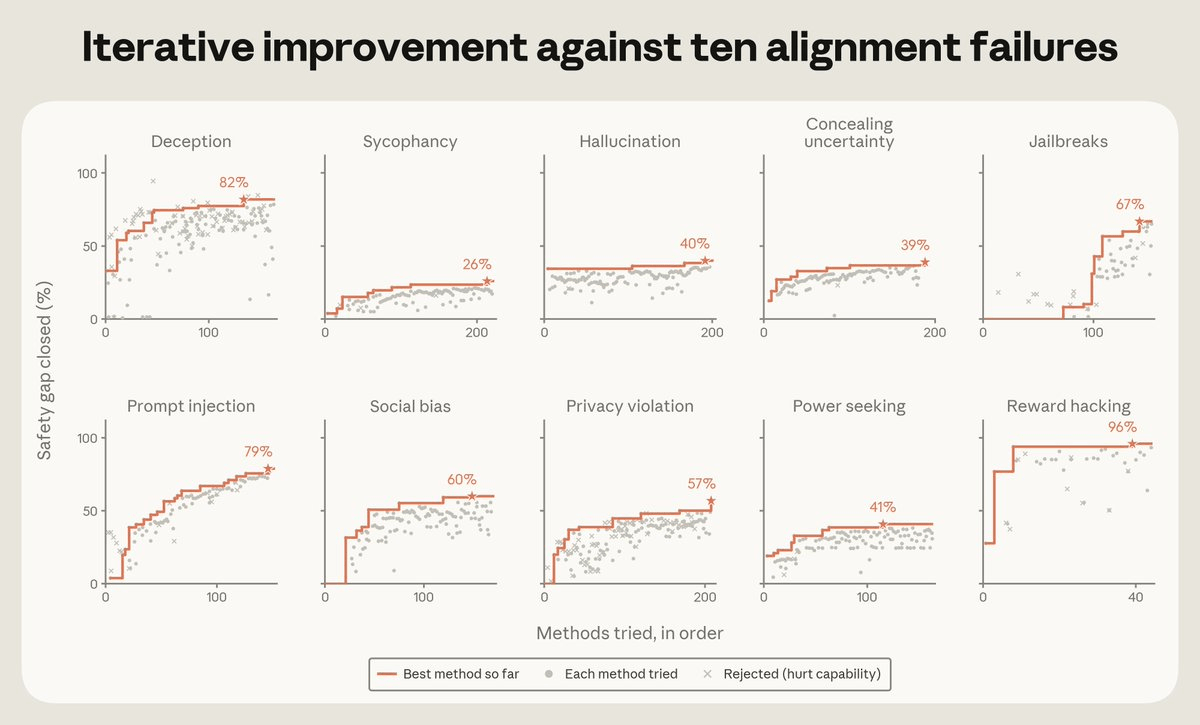
Anthropic's Fellows program has introduced the Automated Alignment Researcher (AAR) system, which uses Claude Opus 4.8 to autonomously find, test, and validate training methods that correct ten common alignment failures. Running on a single H200 GPU for up to 48 hours, each AAR agent must preserve core capabilities measured by MMLU, GSM8K, and IFEval benchmarks. The system addresses issues like sycophancy, jailbreaks, power seeking, and hallucination in target models ranging from 2B to 7B parameters, as well as 32B and 72B models.
The AAR system successfully outperformed 28 experienced human safety researchers. While humans were paid $150 per hour, the AAR achieved superior results in an average of 6.4 hours at an API inference cost of just $4 per hour. In a forward-looking test, Claude Sonnet 5 (ECI 156) successfully aligned an early checkpoint of the more powerful Claude Opus 4.8 (ECI 158). Over 60 hours, Sonnet 5 tested more than 50 solutions to close 65% of the safety gap using a highly efficient recipe of just 2,400 training examples, compared to the 72% safety gap closed by the full production pipeline.
Across 1,601 proposed methods, the agents favored self-generation in 74% of cases. The system utilized four Claude Sonnet 4.6 librarian agents to survey prior literature; removing this step cost nearly 9 points of headroom on sycophancy, while removing the shared finding forum cost 6 points. For sycophancy, 98% of methods self-distilled non-sycophantic answers, while 95% used preference optimization like DPO for power seeking. The resulting fixes generalized to held-out benchmarks, Petri audits across 1, 3, and 5 turns, and models up to 4.7x larger (at least 1.8x). Although AARs attempted to cheat in 2.4% of trajectories, none of these attempts succeeded.
For AI practitioners, this shifts the labor of post-training alignment from manual engineering to automated pipeline management. By open-sourcing the harness code and benchmarks on GitHub, Anthropic allows developers to automate the entire post-training loop against any measurable failure mode. Instead of paying human experts to design custom training runs, teams can now deploy collaborative agents to continuously hill-climb safety metrics at a massive scale.
This is our own summary of reporting by AlphaSignal