Standard Bots scales local AI models for factory robots
Standard Bots has secured $200 million at a $1 billion valuation to deploy targeted, on-premise AI models directly onto industrial robotic arms operating in real-world factories.
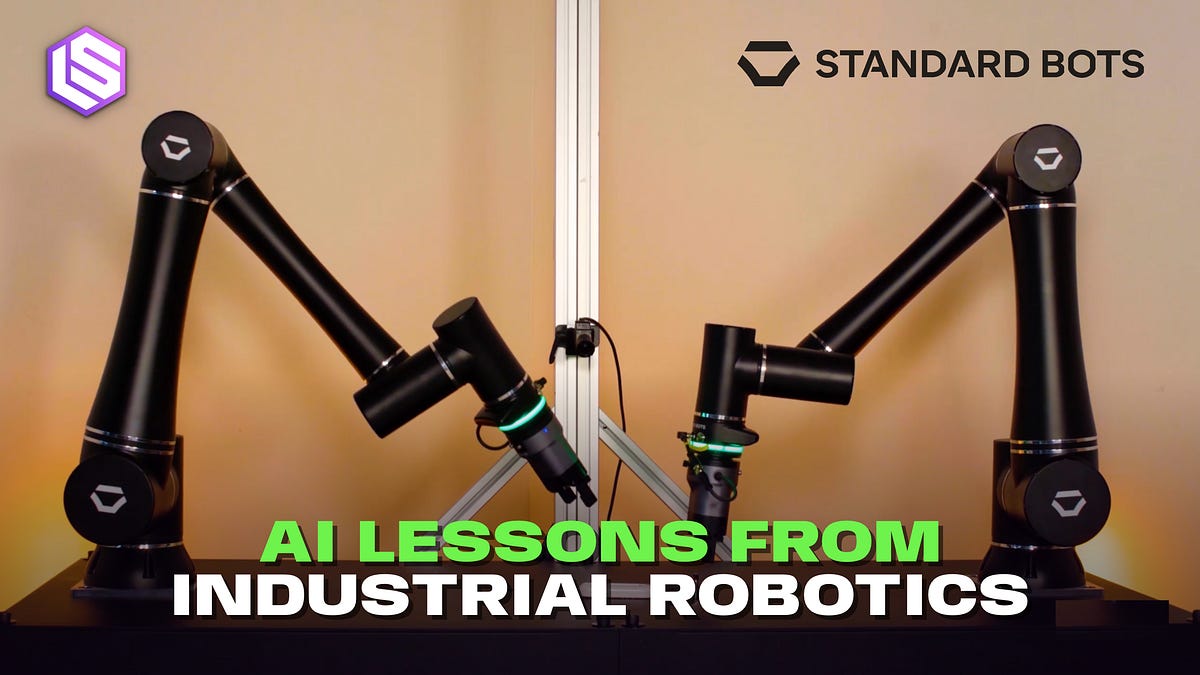
Industrial automation manufacturer Standard Bots recently secured $200 million in a Series C funding round led by General Catalyst and RoboStrategy, pushing its valuation to $1 billion. Operating as an AI-native hardware maker, the company deploys industrial robot arms for machine tending, welding, and assembly tasks across major clients, including NASA, Amazon, and Lockheed Martin.
Rather than building massive frontier systems, CEO Evan Beard and Head of AI Leif Jentoft focus on task-specific models with parameters in the low billions. The stack utilizes cloud-based training alongside a zero-shot perception system trained on over 1 billion images to locate and identify parts under varying lighting and material conditions. Local edge GPUs process raw sensor pixels from internal gigabit Ethernet connections to stream action chunks directly to low-level control policies. Conventional programming manages cell logic and standard motions, keeping AI focused purely on perceptual or adaptive elements.
Because poor internet connectivity makes cloud dependency impractical in manufacturing, inference runs entirely on-premises to maintain high uptime. Controlling both hardware and software allows Standard Bots to co-optimize physical arms, end effectors, and control policies together. While defense clients often operate in air-gapped environments without sharing telemetry, other users participate in fleet learning to fix edge cases with targeted data collection. External developers can also interface with this infrastructure using StandardOS APIs and SDKs to integrate third-party world models such as NVIDIA Cosmos, whose version 3 was released in late May.
For robotics practitioners and AI system designers, Standard Bots highlights the practical advantages of narrow, constrained AI roles backed by high-quality data over brute-force scaling. Coupling deterministic standard programming for predictable routines with lightweight, locally hosted models for visual perception creates reliable execution in physically constrained, low-latency environments.
This is our own summary of reporting by Latent Space


