GPT-4o uses internal confidence to decide when to answer
Researchers have found causal evidence that large language models like GPT-4o use internal confidence signals to decide whether to answer or abstain, a key step toward safer autonomous AI.
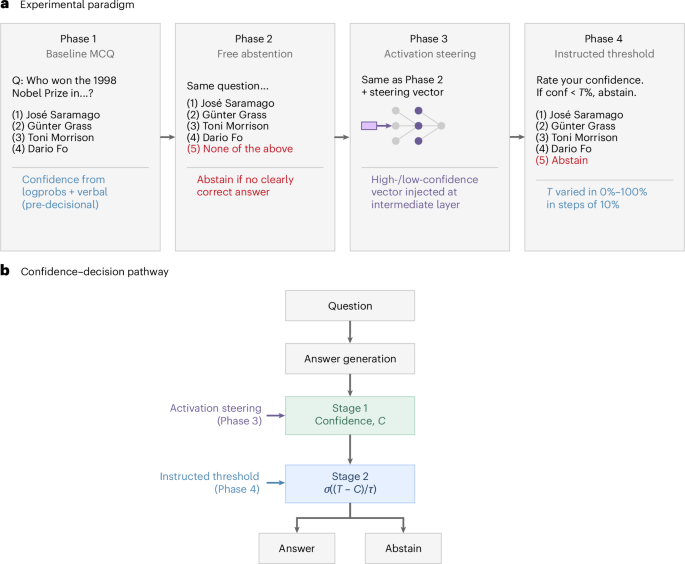
A new study published in Nature Machine Intelligence has demonstrated that large language models utilize an internal sense of confidence to guide their decisions, specifically when choosing whether to answer a question or abstain. Researchers evaluated several models, focusing primarily on OpenAI's GPT-4o. In initial testing without an abstention option, GPT-4o achieved a 63.7 percent accuracy rate. After calibrating the model's logits using temperature scaling, researchers found that this calibrated confidence strongly predicted error rates. When given the option to abstain, GPT-4o's accuracy on answered questions rose to 69.1 percent, while it chose to abstain on 56.6 percent of trials.
Statistical modeling revealed that calibrated confidence was the single dominant driver of the model's decision to abstain, with a standardized effect size of 0.99. This was roughly ten times larger than alternative factors like objective question difficulty, retrieval-augmented generation scores, or sentence embedding similarities. The model's implicit decision threshold, or indifference point where it abstained half the time, was located at 77 percent confidence. This indicates that the model naturally requires high certainty before committing to an answer.
To establish a causal link, the researchers performed activation steering on Google's Gemma 3 27B. By injecting high- or low-confidence vectors at intermediate layers, specifically peaking at layer 31, they manipulated the model's behavior. High-confidence steering slashed abstention rates down to 7.0 percent, while low-confidence steering raised them to 66.5 percent, representing a 59.5 percentage point swing. A mediation analysis confirmed that 67.1 percent of this steering effect was driven by a direct redistribution of internal confidence, rather than a shift in the decision policy itself.
For AI practitioners, these findings confirm that language models possess what researchers call a 'native internal sense of confidence' that directly influences their behavior. Instead of relying on expensive post-hoc thresholding or specialized fine-tuning to prevent hallucinations, developers can exploit these native metacognitive pathways. Understanding how models read out and act on their own uncertainty is crucial for building safer autonomous agents, particularly in high-stakes industries like medicine where a clean refusal is far safer than an incorrect guess.
This is our own summary of reporting by Nature Machine Learning


