DoorDash Flux Platform Runs 130,000 Tasks in the Cloud
DoorDash has launched Flux, a cloud platform that moved AI engineering agents off local laptops to automate 130,000 tasks monthly while improving security and resource management.
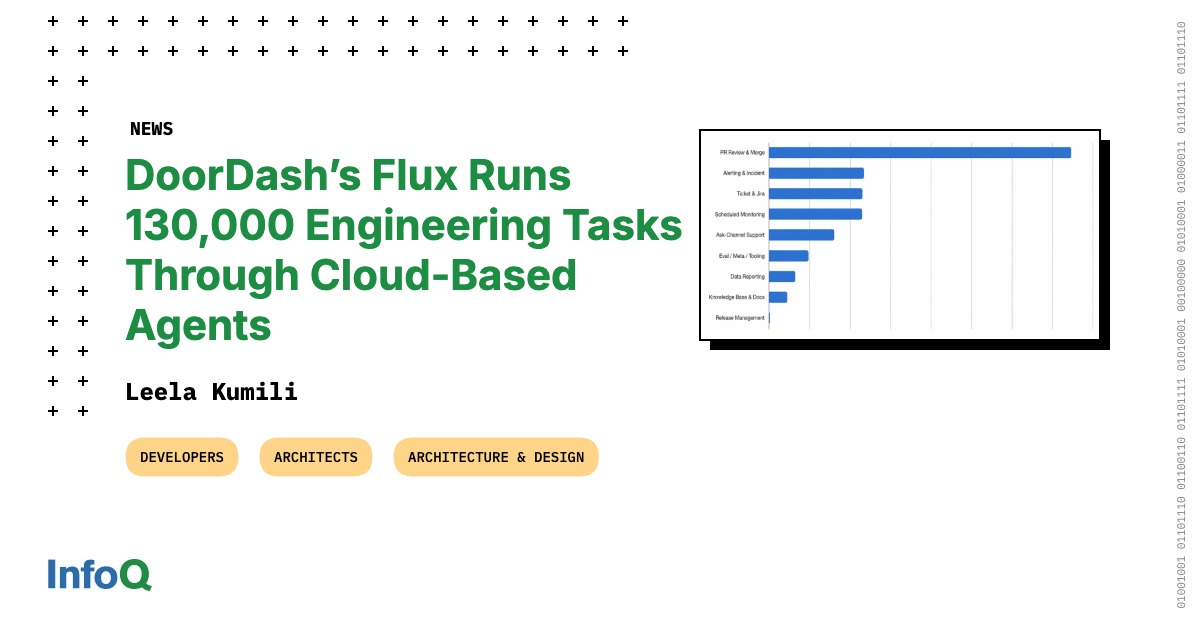
DoorDash transitioned its autonomous engineering agent workloads from local developer laptops to its new cloud-based platform, Flux. In a single month in 2026, the system automated 130,000 engineering tasks. Flux currently handles more than 25,000 automated code reviews every week, utilizing over 300 playbooks and generating more than 10,000 weekly invocations. This cloud-native setup allows workflows to run concurrently and unattended.
The delivery giant developed Flux to overcome the physical and security limitations of running agents on individual laptops. Local execution restricted available CPU and memory, required developers to keep their machines powered on and connected, and exposed sensitive internal credentials to autonomous agents. Furthermore, tracking where agents ran, what systems they accessed, and on whose behalf they operated proved difficult for security teams.
Flux relies on four core primitives: cloud sandboxes, an internal Model Context Protocol (MCP) gateway, reusable playbooks, and invocation surfaces. The sandboxes use Firecracker micro virtual machines to isolate workloads. DoorDash achieves a 95th percentile service level objective of under five seconds to fully provision a sandbox, which includes launching the microVM, cloning repositories, installing build tools, and configuring the coding agent harness. The custom Agent Gateway manages scoped permissions and logs all activity, while YAML-based playbooks define tasks, tools, and safety boundaries.
For software engineers, this shift changes how they interact with automated tools. Workflows can be triggered via Slack, GitHub, cron jobs, command-line tools, or conversational interfaces. DoorDash initially used Flux for automated code reviews but has since expanded its use to continuous integration triage, on-call duties, maintenance tasks, and ticket-driven development. By moving agent interactions to public Slack threads, the company also enabled developers to observe agent executions in real time and learn how other teams delegate work.
This is our own summary of reporting by InfoQ AI

%22%3E%0A%3Cstop%20offset%3D%220%25%22%20stop-color%3D%22%231a1c1c%22%2F%3E%3Cstop%20offset%3D%22100%25%22%20stop-color%3D%22%234c4546%22%2F%3E%0A%3C%2FlinearGradient%3E%3C%2Fdefs%3E%0A%3Crect%20width%3D%22800%22%20height%3D%22500%22%20fill%3D%22url(%23g)%22%2F%3E%0A%3Cg%20stroke%3D%22%23ffffff%22%20stroke-opacity%3D%220.10%22%20stroke-width%3D%222%22%3E%0A%3Cline%20x1%3D%22-200%22%20y1%3D%22500%22%20x2%3D%22100%22%20y2%3D%220%22%2F%3E%3Cline%20x1%3D%22-60%22%20y1%3D%22500%22%20x2%3D%22240%22%20y2%3D%220%22%2F%3E%3Cline%20x1%3D%2280%22%20y1%3D%22500%22%20x2%3D%22380%22%20y2%3D%220%22%2F%3E%3Cline%20x1%3D%22220%22%20y1%3D%22500%22%20x2%3D%22520%22%20y2%3D%220%22%2F%3E%3Cline%20x1%3D%22360%22%20y1%3D%22500%22%20x2%3D%22660%22%20y2%3D%220%22%2F%3E%3Cline%20x1%3D%22500%22%20y1%3D%22500%22%20x2%3D%22800%22%20y2%3D%220%22%2F%3E%3Cline%20x1%3D%22640%22%20y1%3D%22500%22%20x2%3D%22940%22%20y2%3D%220%22%2F%3E%3Cline%20x1%3D%22780%22%20y1%3D%22500%22%20x2%3D%221080%22%20y2%3D%220%22%2F%3E%0A%3C%2Fg%3E%0A%3Ctext%20x%3D%2248%22%20y%3D%22430%22%20font-family%3D%22Helvetica%2CArial%2Csans-serif%22%20font-size%3D%22132%22%20font-weight%3D%22800%22%0A%20fill%3D%22%23ffffff%22%20fill-opacity%3D%220.22%22%20letter-spacing%3D%22-4%22%3ETD%3C%2Ftext%3E%0A%3C%2Fsvg%3E)