Z.ai Launches GLM-5.3 to Challenge US Frontier Models
Z.ai has announced GLM-5.3, a 750-billion-parameter model that rivals US frontier systems through advanced post-training, proving Chinese labs can match top AI capabilities with less compute.
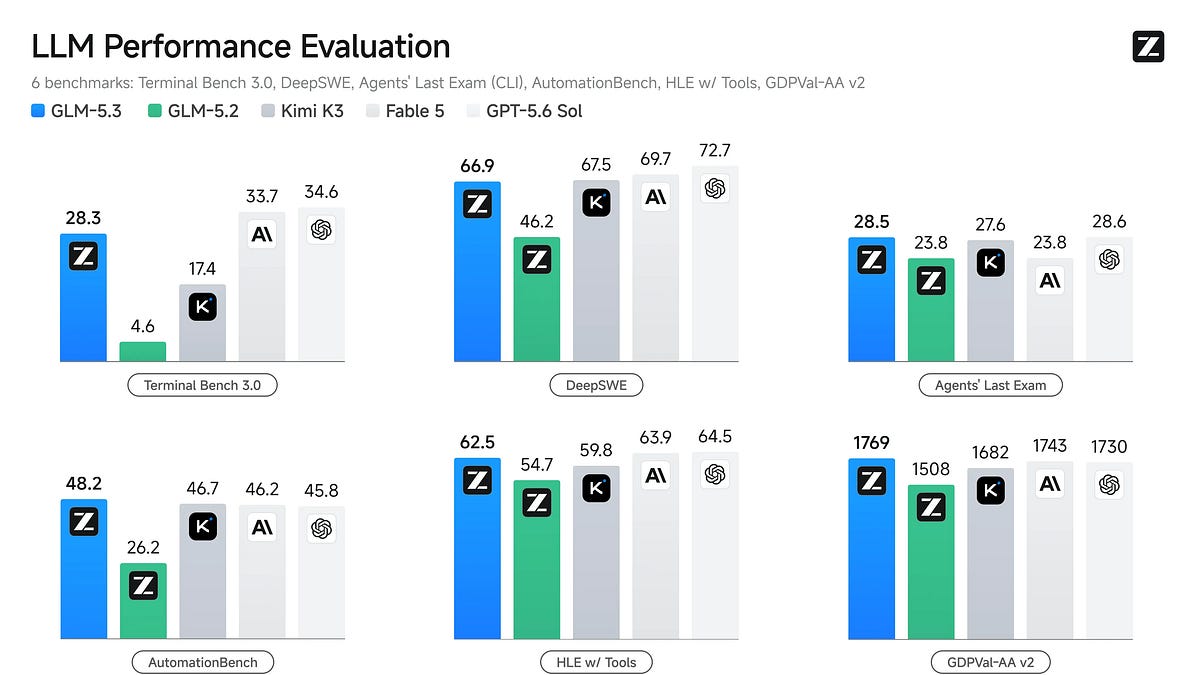
Chinese AI developer Z.ai has announced GLM-5.3, a text-only model boasting approximately 750 billion parameters. Currently available only in the company's coding plan, the model is scheduled to arrive soon on its API and will release as open weights on Hugging Face in two weeks. Despite being a third of the size of Moonshot AI's Kimi K3, GLM-5.3 has surpassed Kimi K3 on multiple benchmarks and has even outperformed Claude Fable 5 and GPT-5.6-Sol on select tests. This achievement places the model at the absolute frontier of agentic coding benchmarks.
According to Z.ai, the model achieves these results entirely through scaling post-training rather than pretraining from scratch. It utilizes the same base model as GLM-5.2, which was released on June 22, 2026, but applies an intensive reinforcement learning regime with more environments and diverse tasks. This release continues a long lineage of models, starting with the original GLM in March 2021 by Tsinghua University's THUDM group, followed by GLM-130B in August 2022, ChatGLM on March 14, 2023, GLM-4 on January 16, 2024 (with GLM-4-9B in June), and GLM-5 on February 11, 2026.
For AI practitioners, GLM-5.3 demonstrates that massive compute and parameter sizes are not the only paths to frontier-level performance. By focusing on a narrower, text-only scope compared to omnimodal systems like Inkling-Small, and avoiding the overhead of visual capabilities, Z.ai has optimized the model for high-value tasks like agentic coding and cybersecurity. The model delivers substantial improvements in vulnerability discovery and exploit analysis. Because Z.ai, which has reached 1 billion dollars in annual recurring revenue, plans to release the weights openly, developers will soon gain access to a highly efficient, customizable frontier-grade model without being locked into US-based proprietary APIs.
This is our own summary of reporting by Interconnects