Google Antigravity Debuts /boost for Multi-Agent Coding
Google has introduced a new /boost command for its Antigravity platform, enabling a multi-agent reasoning pipeline that automates the resolution of highly complex software bugs.
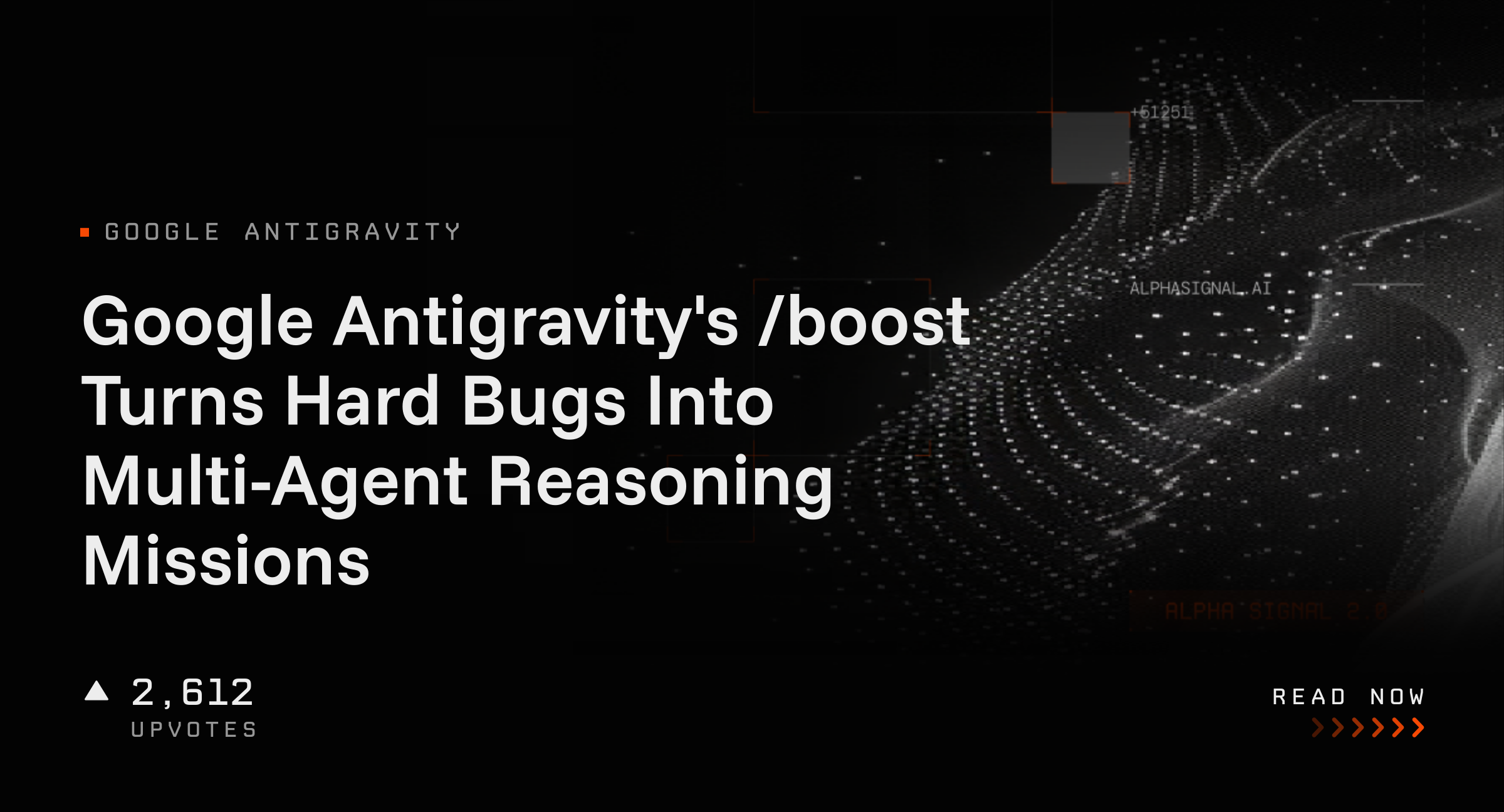
Google has expanded its agentic development platform with the launch of the /boost command, now available for Pro and Ultra subscribers on Google Antigravity 2.0 and the Antigravity CLI. This new feature introduces an on-demand, multi-agent reasoning pipeline designed to tackle complex programming challenges that typically cause standard, single-shot coding assistants to fail. By prefixing a prompt with /boost, developers can trigger a deeper, token-heavy workflow that automates planning, exploration, and verification across isolated worktrees.
The underlying architecture of /boost relies on a three-phase execution pipeline. First, a Primary Orchestrator analyzes the workspace context to formulate a strategy and divide the problem into verifiable subtasks. Next, specialized subagents execute these tasks in parallel, running local builds and test suites to validate their work in isolated scopes. Finally, the orchestrator synthesizes the solution, running regression checks and feeding failed assertions back into the loop for automated correction. Powered primarily by Gemini 3 Pro—which is optimized for tool use and performs strongly on the Terminal-Bench benchmark—the system can also route tasks to other models like Claude Sonnet via Vertex AI.
This new command occupies a middle tier in Antigravity's execution modes, sitting between the default single-agent loop, which resolves tasks in seconds or minutes, and the /teamwork-preview mode, which deploys autonomous multi-role teams for campaigns lasting hours or days. The /boost workflow operates over a span of seconds to hours, specifically targeting four difficult scenarios: reproducing intermittent race conditions, implementing complex algorithmic optimizations, performing multi-file refactoring, and conducting deep root-cause investigations in unfamiliar codebases.
For software engineers, this update productizes a sophisticated workflow that previously required manual orchestration. Instead of manually breaking down hard problems, running parallel tests, and merging results, developers can now delegate these tasks through a single command. While there is no extra per-call fee, users should expect higher token consumption due to the parallel subagents. Security is maintained as subagents inherit existing workspace permission policies, requiring explicit user confirmation before executing protected terminal commands or file edits.
This is our own summary of reporting by AlphaSignal

%22%3E%0A%3Cstop%20offset%3D%220%25%22%20stop-color%3D%22%231a1c1c%22%2F%3E%3Cstop%20offset%3D%22100%25%22%20stop-color%3D%22%234c4546%22%2F%3E%0A%3C%2FlinearGradient%3E%3C%2Fdefs%3E%0A%3Crect%20width%3D%22800%22%20height%3D%22500%22%20fill%3D%22url(%23g)%22%2F%3E%0A%3Cg%20stroke%3D%22%23ffffff%22%20stroke-opacity%3D%220.10%22%20stroke-width%3D%222%22%3E%0A%3Cline%20x1%3D%22-200%22%20y1%3D%22500%22%20x2%3D%22100%22%20y2%3D%220%22%2F%3E%3Cline%20x1%3D%22-60%22%20y1%3D%22500%22%20x2%3D%22240%22%20y2%3D%220%22%2F%3E%3Cline%20x1%3D%2280%22%20y1%3D%22500%22%20x2%3D%22380%22%20y2%3D%220%22%2F%3E%3Cline%20x1%3D%22220%22%20y1%3D%22500%22%20x2%3D%22520%22%20y2%3D%220%22%2F%3E%3Cline%20x1%3D%22360%22%20y1%3D%22500%22%20x2%3D%22660%22%20y2%3D%220%22%2F%3E%3Cline%20x1%3D%22500%22%20y1%3D%22500%22%20x2%3D%22800%22%20y2%3D%220%22%2F%3E%3Cline%20x1%3D%22640%22%20y1%3D%22500%22%20x2%3D%22940%22%20y2%3D%220%22%2F%3E%3Cline%20x1%3D%22780%22%20y1%3D%22500%22%20x2%3D%221080%22%20y2%3D%220%22%2F%3E%0A%3C%2Fg%3E%0A%3Ctext%20x%3D%2248%22%20y%3D%22430%22%20font-family%3D%22Helvetica%2CArial%2Csans-serif%22%20font-size%3D%22132%22%20font-weight%3D%22800%22%0A%20fill%3D%22%23ffffff%22%20fill-opacity%3D%220.22%22%20letter-spacing%3D%22-4%22%3ETD%3C%2Ftext%3E%0A%3C%2Fsvg%3E)