Google Releases Harness2 for Self-Improving Agents
Google Cloud AI Research has open-sourced Harness2, an Apache-2.0 framework that enhances AI agent performance on unseen tasks by dynamically rewriting outer code components without modifying model weights.
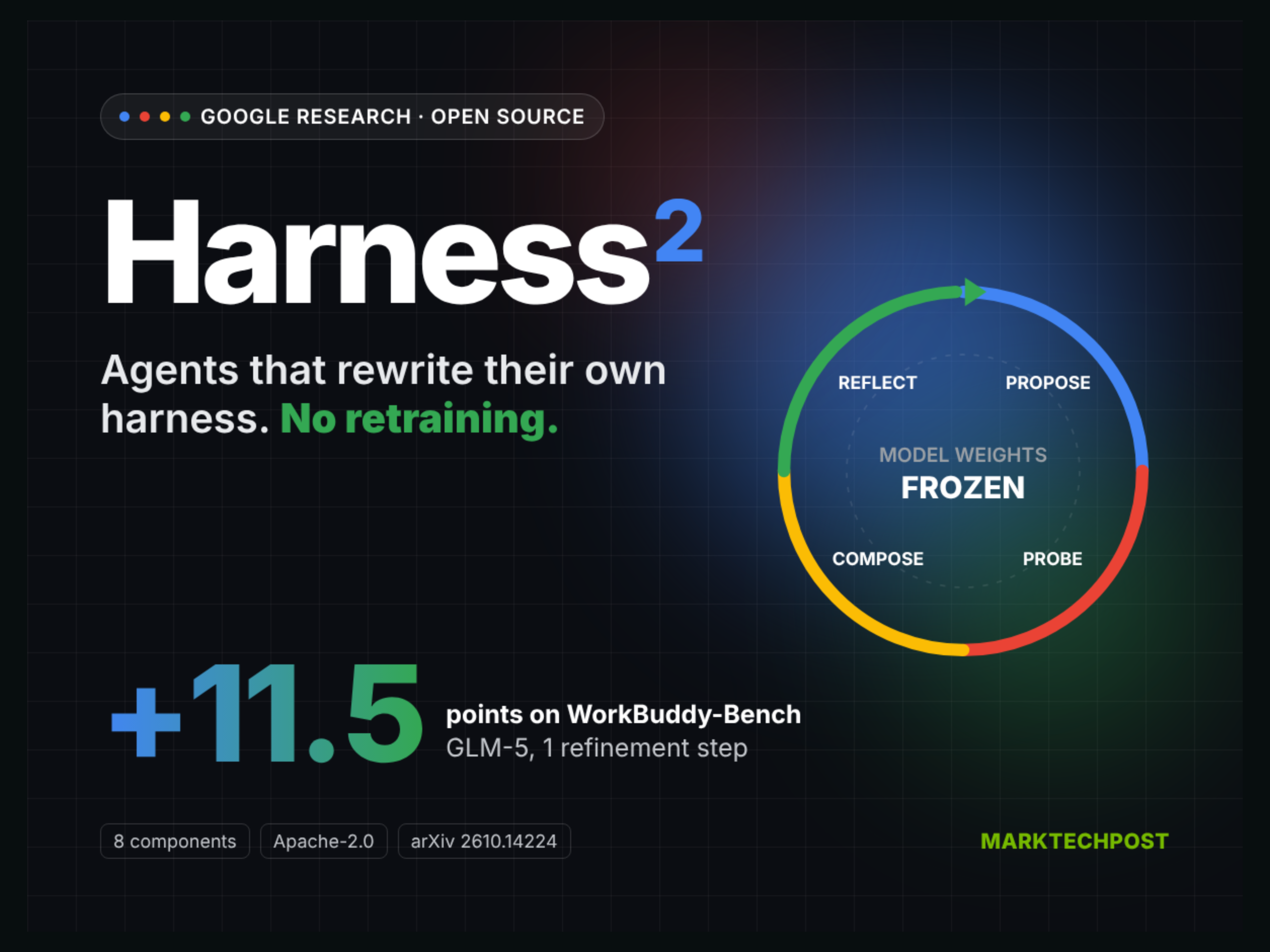
Google Cloud AI Research has released Version 0.1.0 of Harness2, an open-source, zero-parameter framework under the Apache-2.0 license designed to improve AI agents by modifying their external harness rather than retraining underlying models. Operating on Linux environments with Python 3.12 or 3.13 and uv, Harness2 exposes eight editable components mounted as files to manage context construction, tool interfaces, delegation, and loop behaviors. Model execution relies on Vertex AI, while the framework uses a default editor such as Claude Opus 4.8 to iteratively refine agent systems.
The system employs two levels of recursion to operate in open-world settings without test labels or ground-truth verifiers. At the task level, a contrastive Propose, Probe, Compose workflow evaluates an invariant candidate targeting general failures and a domain candidate targeting specific knowledge, keeping only edits validated by observed trajectory data. At the harnessing level, a reflector logs approved harnesses along with an EXPERIENCE.md file to inform future proposals. Evaluated across professional benchmarks including WorkBuddy-Bench, JobBench, and Harvey's LAB using Gemini 3.5 Flash and GLM-5 under OpenCode and Codex, a single refinement step (k=1) raised performance across all setups.
Weaker models experienced the largest gains. For example, GLM-5 under OpenCode jumped from 64.2 to 75.7 on WorkBuddy-Bench, a gain of 11.5 points, while under Codex it moved from 23.6 to 24.8 on JobBench. Gemini 3.5 Flash under OpenCode rose from 72.4 to 77.5 on WorkBuddy-Bench, 31.5 to 36.0 on JobBench, and 79.9 to 81.9 on LAB Partial. Extending the search budget to parallel mode at k=5 pushed Gemini under OpenCode to 80.8 on WorkBuddy-Bench. On that benchmark, three out of four setups also reduced task steps, with Gemini under OpenCode dropping from 25.4 to 21.9 steps per task.
For developers and practitioners, Harness2 demonstrates that AI agents can yield significant performance leaps entirely through test-time harness optimization. Compared offline against methods like Meta-Harness, ReasoningBank, and Harness Scaling, Harness2 delivers competitive or superior performance across benchmarks without requiring pre-existing training splits or offline search steps. However, because it runs multiple candidate probes per task, developers must budget for increased API calls and model execution runs.
This is our own summary of reporting by MarkTechPost