Google's Planetary Prediction Engine Automates Modeling
Google Research has introduced the Planetary Prediction Engine, an experimental AI system that slashes geospatial modeling workflows from weeks to minutes using natural-language queries.
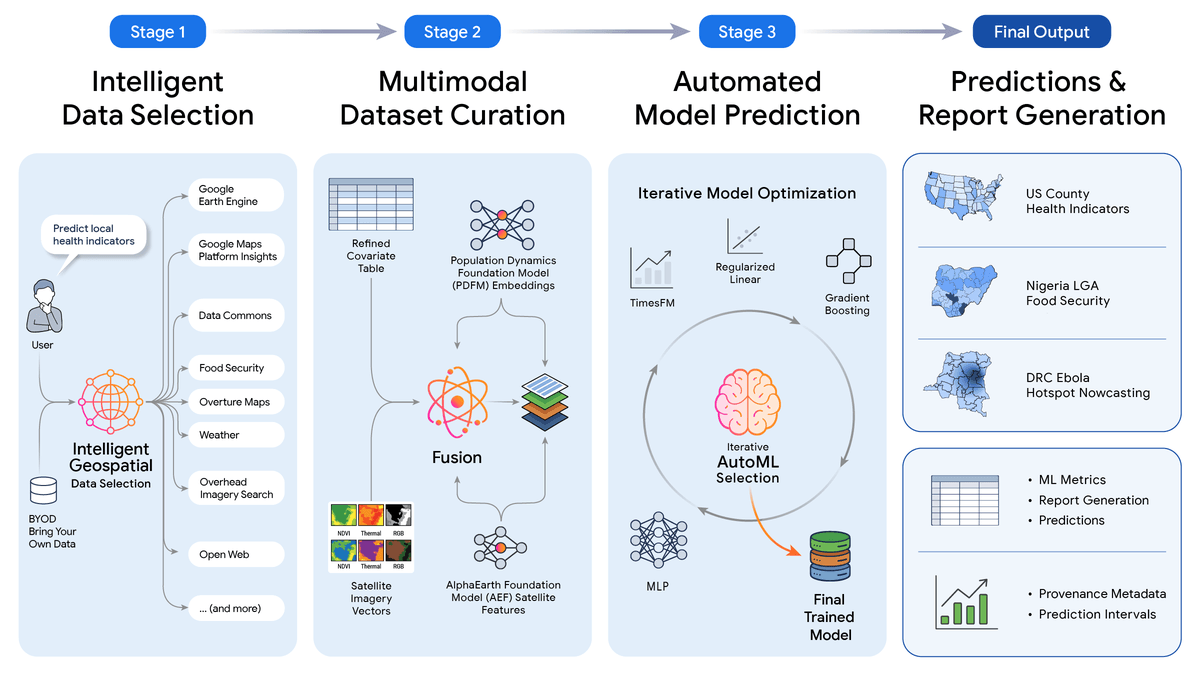
Google Research has introduced the Planetary Prediction Engine (PPE), an experimental system designed to automate geospatial modeling. Traditionally, building planetary-scale models requires weeks of manual data engineering to gather and align satellite imagery, health records, and demographic layers. PPE automates this entire loop from a single natural-language query. It operates in three LLM-orchestrated stages: intelligent data selection from sources like Data Commons and Google Earth Engine, multimodal dataset curation, and automated model training across regularized linear models, gradient-boosted decision trees, and multilayer perceptrons (MLPs).
During the curation phase, PPE fuses structured covariates with pre-trained embeddings from the Population Dynamics Foundation Models (PDFM) and AlphaEarth. To prevent target leakage, a Feature Gate runs four distinct anti-leakage checks, while an Overfitting Guard Protocol manages dataset risk during training. This automated pipeline allows the system to bypass the context window limits of standard large language models by passing data through opaque handles rather than serializing it directly into prompts.
In evaluations, PPE consistently outperformed expert-engineered baselines. On 21 CDC health indicators, it achieved a 76.8% mean R² compared to the 60.0% baseline. For FEMA National Risk Index and Social Vulnerability Index tasks, it reached 64.9% and 66.2% mean R² respectively, up from baselines of 60.0% and 58.6%. In downscaling Nigerian food security data from state to local levels, PPE more than doubled accuracy, scoring 66.1% R² against a 31.5% baseline. Additionally, during a simulated nowcast of the 2026 Bundibugyo ebolavirus outbreak in the Democratic Republic of the Congo, the engine achieved an 83.3% Recall@10, identifying 15 of 18 newly invaded health zones and beating the Bayesian state-of-the-art baseline of roughly 73% by 10.3 percentage points.
For practitioners, PPE shifts the focus from tedious data preparation to hypothesis framing. While currently an experimental capability with no public API or self-serve access, the technology holds significant promise for humanitarian groups, epidemiologists, and disaster risk analysts. By encoding tacit geospatial knowledge into an autonomous loop, the engine allows non-specialists to generate high-fidelity predictions in minutes rather than weeks.
This is our own summary of reporting by AlphaSignal