Kyutai Unveils REKI 2.4B Model for Robot Manipulation
Kyutai has released REKI, a 2.4B vision-language-action model that uses an efficient register memory mechanism to match or outperform robotics models twice its size on public benchmarks.
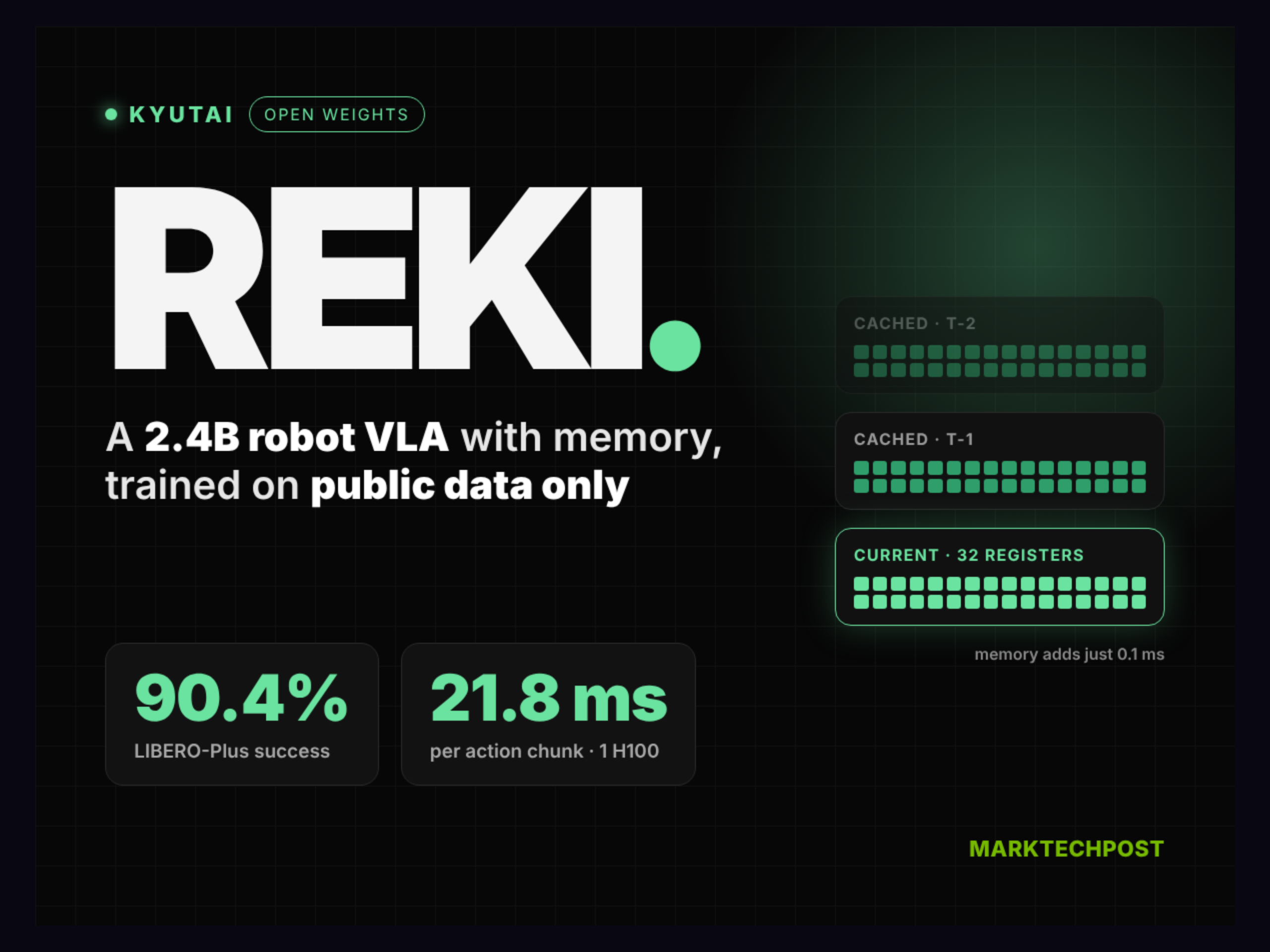
AI research lab Kyutai, in collaboration with Inria and École des Ponts, has released REKI, an open-weights 2.4B vision-language-action (VLA) model for robot manipulation. The architecture combines a 2.2B Qwen3.5-2B vision-language backbone with a 0.2B flow-matching action expert integrated using 10 Euler steps. Rather than unrolling expensive vision-language frames, REKI stores memory in the action expert using 32 learned register tokens per frame across a three-frame rolling window spaced 1 second apart.
The model was pretrained on public datasets over 200,000 steps using 32 NVIDIA H100 GPUs. Its dataset mix contains 1.0B frames and 12.2M vision-language samples, split across 639.8M real-robot teleoperation frames, 193.9M simulation frames, and 170.9M egocentric human video frames from sources including DROID, BridgeData V2, AgiBot World, EgoDex, and EgoVerse. Pretraining raised benchmark scores by 13.8 points on RoboTwin Clean2Rand and 30.3 points under visual clutter, while memory integration provided gains of 1.5 points on LIBERO-Plus and 5.4 points on RoboCasa365.
Evaluating benchmarks, REKI achieved a top score of 90.4% on LIBERO-Plus, outperforming Qwen-RobotManip (89.0%), π0.5 (85.7%), and ABot-M0 (80.5%). On RoboTwin Clean2Rand, REKI scored 65.8%, behind Qwen-RobotManip (68.5%) but ahead of π0.5 (63.8%) and ABot-M0 (55.7%). On RoboCasa365, REKI posted 38.4%, beating RLDX-1 (36.0%), Qwen-RobotManip (35.9%), and π0.5 (16.9%), while trailing Xiaomi-Robotics-1 (57.4%).
For deployment, REKI operates in BF16 precision on a single NVIDIA H100 GPU with a compiled latency of 21.8 ms per action chunk from two 256×256 camera streams. Caching the 32 registers costs only 2 MiB of GPU memory per past frame and adds just 0.1 ms to chunk latency, while reducing arm pose oscillations from 18.6% to 4.1%. Kyutai released six checkpoints under a non-commercial CC BY-NC-SA 4.0 license, and demonstrated that fine-tuning a UR5 arm via the LeRobot async-inference gRPC protocol requires only 3,000 steps (about 1 hour) across 50 task demonstrations.
This is our own summary of reporting by MarkTechPost