Meta Releases 816B-Parameter Muse Spark Open Model
Meta Superintelligence Labs has published Muse Spark Open, an 816-billion-parameter multimodal model offering 1 million context tokens to challenge rival open-weight systems in agentic tasks.
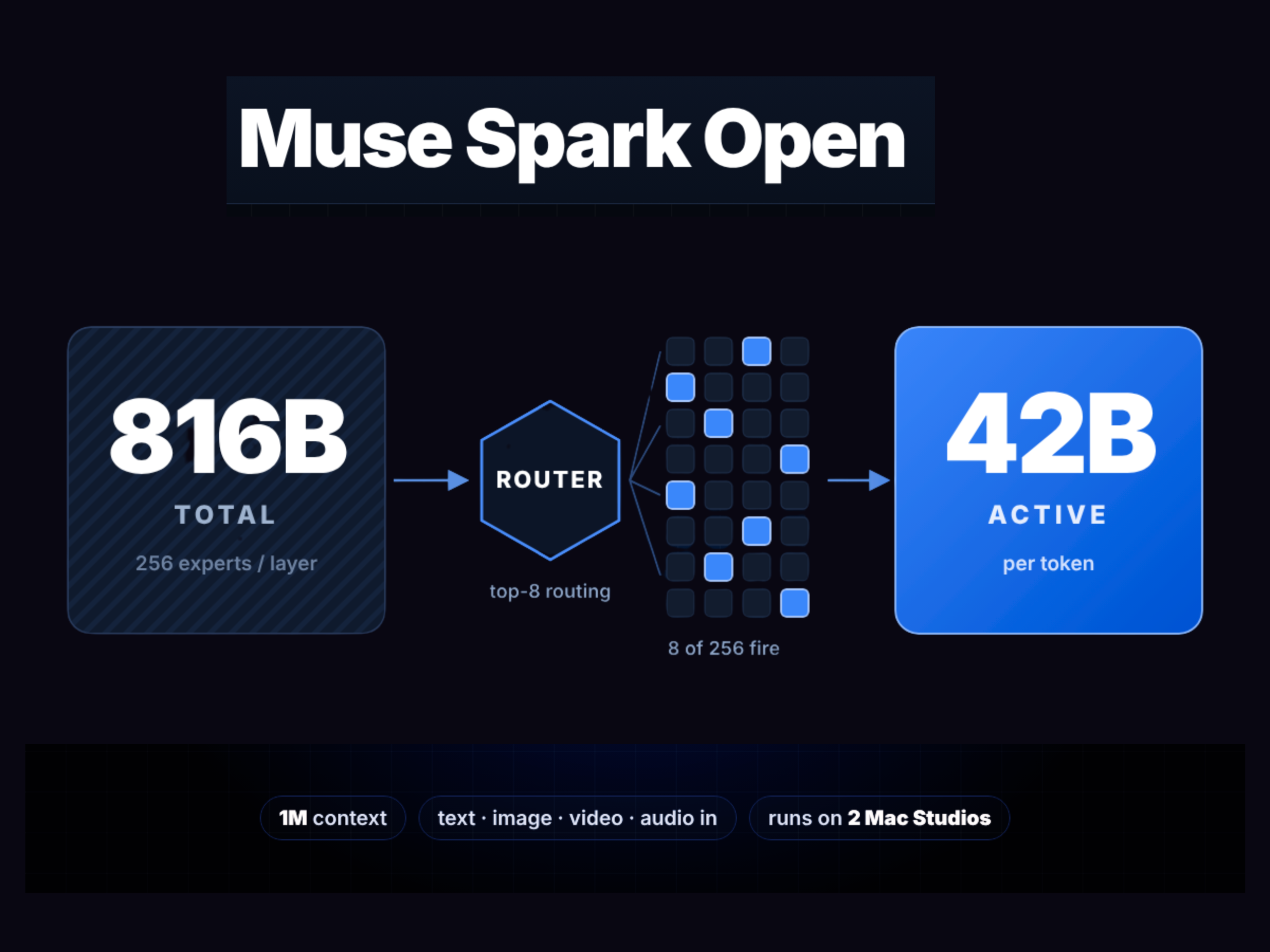
Meta Superintelligence Labs has publicly launched Muse Spark Open, an open-weight mixture-of-experts model featuring 816 billion total parameters with 42 billion active per token across 256 experts. Built with 62 layers, a hidden dimension of 8192, and grouped-query attention using 128 query heads and 16 KV heads, the system processes multimodal inputs including audio, video, text, and images via a 1.8 billion parameter Perception Encoder. It delivers a 1 million token context window and supports adjustable reasoning modes ranging from low to extra-high effort.
The architecture showcases strong performance in agentic workflows, earning top marks on the MCP-Atlas benchmark at 89.2, ahead of Qwen3.8 at 84.5 and GLM 5.3 at 84.2. On JobBench, it recorded 61.8 compared to GLM 5.3 at 61.4, while reaching 26.1 on toolless HLE-Diamond, 25 on AA Omniscience, and 50.0 on ZeroBench with tools. Additional vendor scores include 72.8 on Toolathlon Verified, 61.0 on HLE with tools, and 60 on DeepSWE 1.1. However, coding benchmarks remain a vulnerability; on Terminal-Bench 2.1, its score of 76.4 lags behind Kimi K3 at 85.0, GLM 5.3 at 83.9, and Qwen3.8 at 82.0. Its overall Artificial Analysis Intelligence Index score of 39 trails competitors like GLM 5.3 at 45, Kimi K3 at 44, and Qwen3.8 at 40.
For deployment, the unquantized BF16 weights span roughly 1.6 TB, requiring 2 TB of VRAM, whereas the NVFP4 version shrinks expert weights down to roughly 530 GB, needing 700 GB VRAM. Data centers can run NVFP4 across four Blackwell Ultra GPUs or eight H200s, while desktop local setups can utilize MLX tensor parallelism on two Apple M5 Ultra Mac Studios equipped with 512 GB memory apiece over Thunderbolt 5 with RDMA. Unsloth Dynamic 2-bit GGUF quantizations reduce hardware requirements to roughly 300 GB. Supported day-one runtimes include vLLM, SGLang, TensorRT-LLM, llama.cpp, and Hugging Face Transformers, alongside speculative decoding acceleration through draft models DFlash V2—which delivers 3.7x throughput on AMD MI355X hardware—and DSpark. Fine-tuning is enabled via TorchTitan, Hugging Face TRL, and NVIDIA NeMo AutoModel. Hosted API providers like OpenRouter price access at $1.25 per million input tokens and $4.25 per million output tokens, while commercial entities earning over $20 million in annual revenue face custom licensing terms.
This is our own summary of reporting by MarkTechPost