NVIDIA AVO Framework Solves Every ARC-AGI-3 Public Level
NVIDIA's AVO framework scored 100 percent on the ARC-AGI-3 public benchmark, showing how advanced scaffolding can dramatically boost a standard language model's reasoning capabilities.
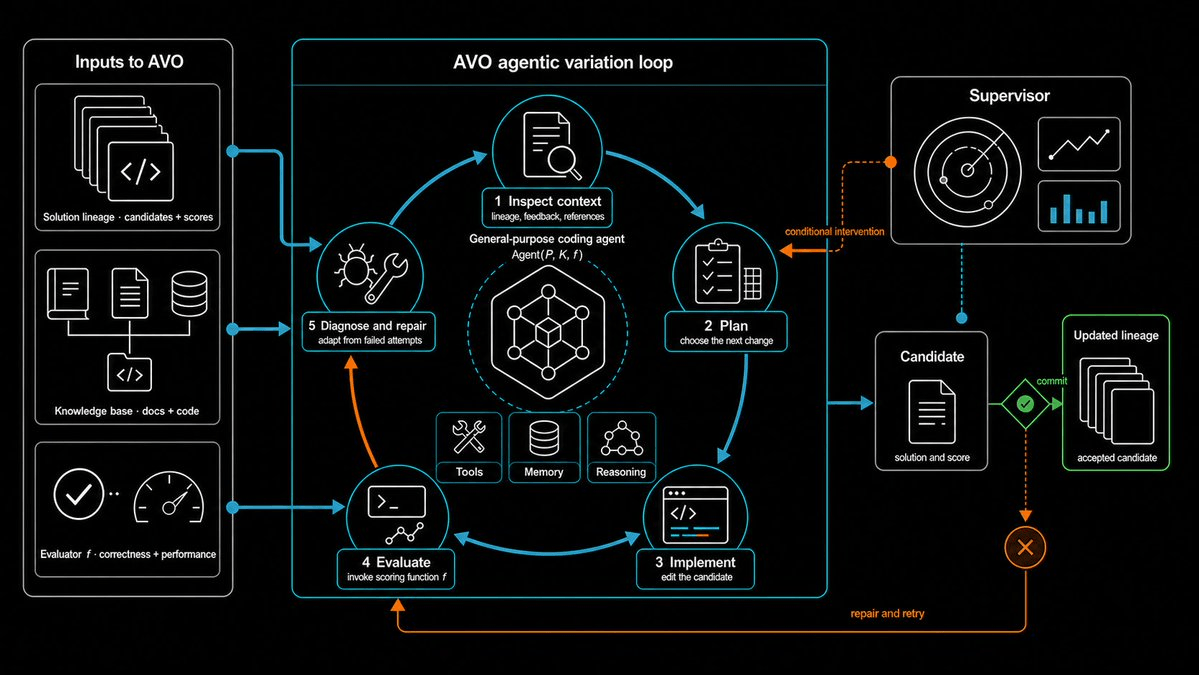
NVIDIA has introduced Agentic Variation Operators (AVO), an agent framework that cleared all 183 public levels of the ARC-AGI-3 benchmark with a perfect 100.00 Relative Human Action Efficiency (RHAE) score. This milestone is particularly notable because the underlying model, Claude Opus 5 (High), scores just 30.2% on the same benchmark when evaluated on its own. By wrapping the model in a specialized harness, AVO completed the 25-environment public set using 6,624 environment actions. This represents a 12% efficiency gain over the competing VISTA framework, which required 7,542 actions to solve the same levels.
The AVO architecture operates entirely in a text-only modality, processing observations as 64x64 text grids with no visual tokens. It achieves its results through an iterative inspect-plan-implement-evaluate loop. This cycle is supported by persistent memory that preserves prior implementations and evaluation results, alongside a supervisor agent designed to redirect the system if it gets stuck in unproductive loops. NVIDIA also tested the framework with GPT-5.6 Sol as a backend, indicating that the architecture is model-agnostic.
Beyond puzzles, NVIDIA tested AVO on writing high-performance GPU code. Operating continuously for seven days on NVIDIA DGX B200 systems, the agent explored over 500 optimization directions to produce 40 committed kernel versions. The resulting multihead attention kernels outperformed cuDNN by up to 3.5% and FlashAttention-4 by up to 10.5%. AVO then autonomously adapted the evolved kernel to grouped-query attention in about 30 minutes.
For AI practitioners, these results demonstrate that the design of an agent's scaffolding is just as critical as the frontier model powering it. Developers can achieve massive performance leaps on complex, long-horizon tasks by focusing on persistent memory and supervisory loops rather than waiting for larger base models. While the seven-day optimization run highlights significant compute overhead, it proves that structured agent loops can successfully tackle highly specialized engineering challenges.
This is our own summary of reporting by AlphaSignal