LTX Launches LTX-2.5 Open Weights Video Model
LTX has released LTX-2.5, an open-weights video generation model optimized for local NVIDIA GPUs that allows creators to produce consistent, high-quality video sequences without cloud fees.
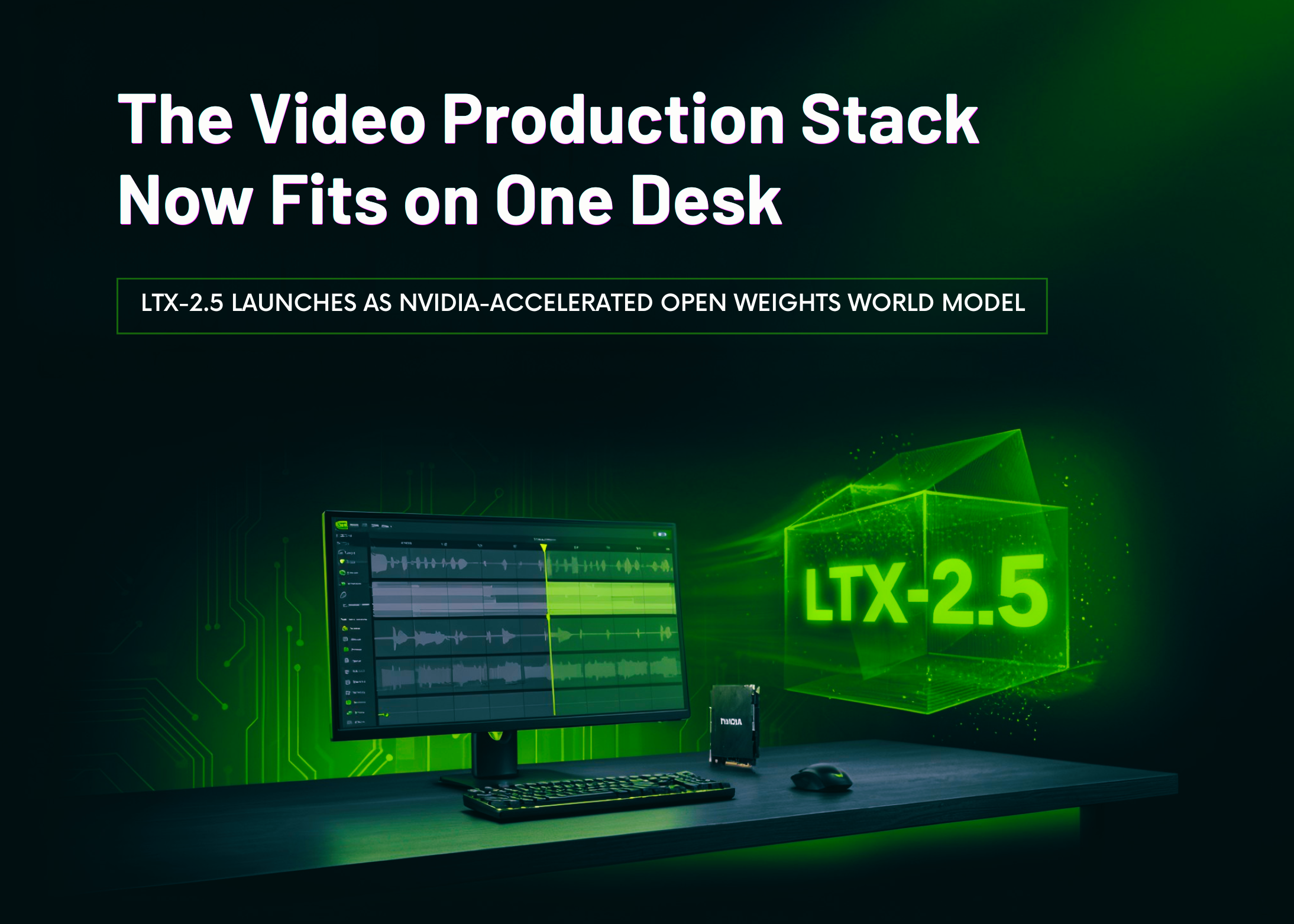
LTX has launched LTX-2.5, an open-weights world model designed for video generation, physical AI, and real-time applications. Optimized for local execution on NVIDIA RTX GPUs and NVIDIA DGX Spark, the model lowers VRAM requirements to run directly on creator hardware. The release features a new diffusion video decoder to reduce visual artifacts in high-motion scenes, native multishot generation to maintain character consistency across cuts, and a Gemma 4 language backbone for complex prompt comprehension. It also utilizes Diffusion Fidelity Rendering with an 8x temporally compressed latent space to generate high-fidelity keyframes.
In performance benchmarks, LTX-2.5 demonstrates significant speed advantages. Generating a 10-second video clip takes just 6.8 seconds on-premise using two NVIDIA GB200 GPUs, and 23.7 seconds via the LTX API. This outpaces closed-source competitors; Omni Flash, Grok 1.5, and Veo 3.1 take between 52 and 70 seconds. Slower alternatives lag even further behind, with Seedance 2.0 taking 196 seconds, FLUX 3 taking 259 seconds, Seedance 2.5 taking 317 seconds, and Kling 3.0 Pro requiring 398 seconds.
For creative practitioners, this local capability eliminates recurring cloud fees and protects intellectual property. Teams can run overnight batch generations to produce multiple variations for A/B testing, helping combat the typical seven-to-ten-day ad fatigue cycle. The model family, which has surpassed 33 million downloads, also includes a physical AI checkpoint for robotics fine-tuning. LTX-2.5 is available on Hugging Face, GitHub, and natively in ComfyUI. It is free for organizations with under $10 million in annual recurring revenue.
The launch coincides with NVIDIA's local AI showcase, which also introduced Nemotron 3.5 Lightning, a 30-billion parameter mixture-of-experts model, and the NeMo Switchyard routing library. Together, these tools signal a shift toward decentralized, hardware-flexible production environments.
This is our own summary of reporting by MarkTechPost