Flagship Phones Fail to Sustain Agentic AI Workloads
Recent benchmarks reveal that flagship smartphones struggle to sustain the continuous looping workloads required by AI agents, exposing a critical gap in current edge hardware design.
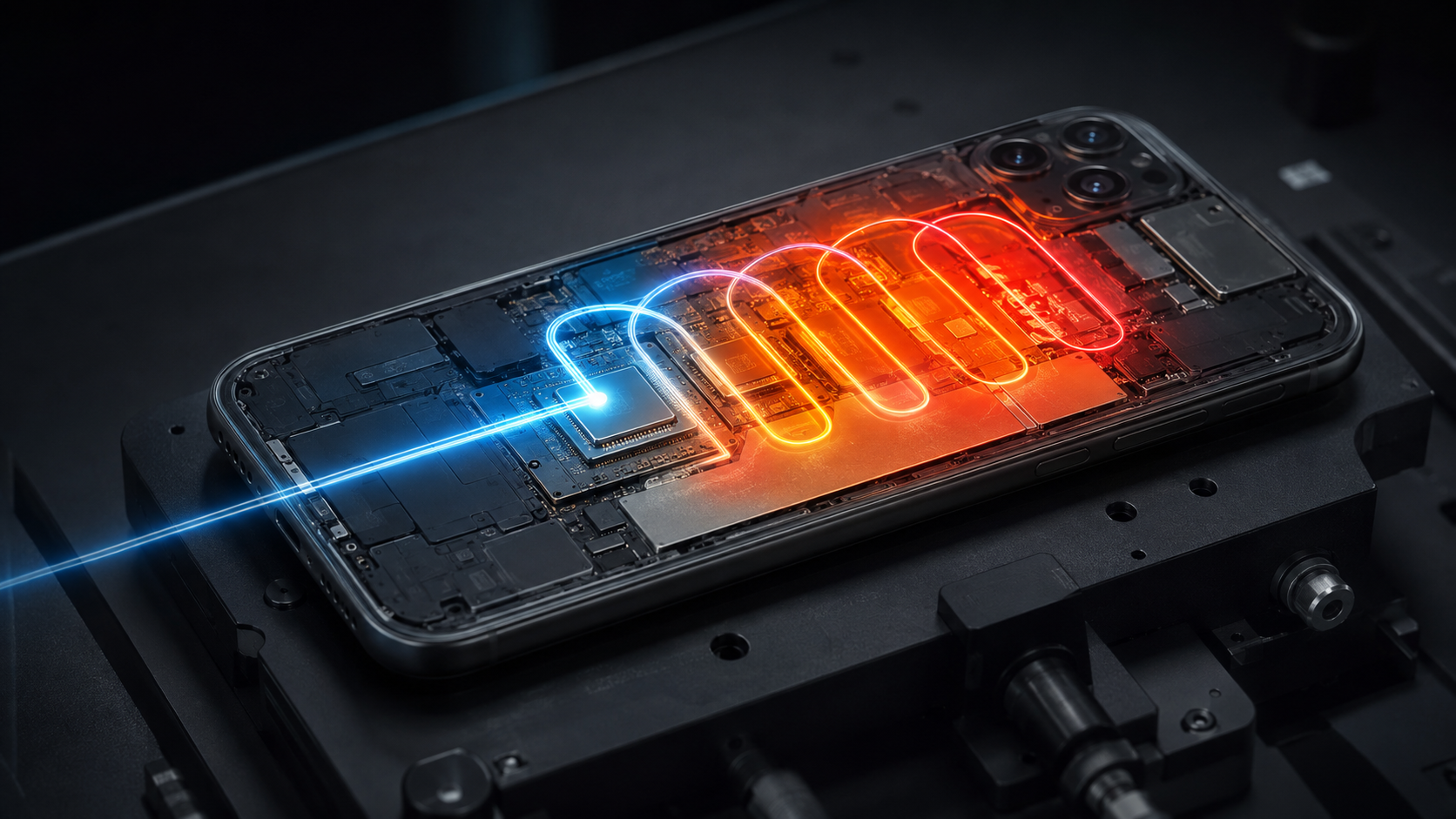
Traditional edge AI benchmarks evaluate hardware using single forward passes, but autonomous agents operate in continuous, unpredictable loops. A March 2026 study highlighted this discrepancy by testing a quantized 1.5-billion-parameter model with a fixed 258-token prompt across 20 consecutive runs. The results showed that top-tier smartphones are unprepared for the sustained thermal demands of agentic workflows, which require significantly more power than simple tasks. For context, text generation costs about 0.047 kWh per 1,000 inferences compared to just 0.002 kWh for text classification, while a full smartphone charge holds only 0.022 kWh.
During the tests, an iPhone 16 Pro initially peaked at 40.35 tokens per second but began degrading within just two inferences. It ultimately throttled down to 22.56 tokens per second—a 44 percent performance reduction—and remained throttled for 65 percent of the benchmark. The Galaxy S24 Ultra fared even worse under the sustained load. At the sixth iteration, its Android thermal governor hit a hard GPU limit at 78.3°C, causing the inference process to stop entirely and rendering the system unusable.
Conversely, specialized hardware like the Hailo-10H NPU demonstrated the value of prioritizing efficiency over raw speed. The Hailo-10H delivered a modest 6.9 tokens per second at under 2 watts, but maintained an incredibly steady throughput with a coefficient of variation of just 0.04 percent. When measured by energy efficiency, the NPU consumed 270.5 millijoules per token, outperforming a laptop GPU that ran at 131.7 tokens per second using 34.1 watts, which averaged 297.3 millijoules per token.
For AI developers, these findings suggest that edge hardware should be selected based on joules per completed task rather than peak tokens per second. To prevent agent failure as devices heat up and memory-bound context caches expand, developers must design agents with strict turn limits. Feeding real-time hardware constraints, such as battery status and thermal throttling, directly into the agent's context window will allow the system to gracefully conclude its loop before the operating system forces a shutdown.
This is our own summary of reporting by Unite.AI