Ant Group Releases Open 560B Ling-3.1-flash Model
Ant Group’s InclusionAI has released Ling-3.1-flash under an MIT license, bringing a 560-billion-parameter model to four-GPU Hopper setups while supporting a 1-million-token context window.
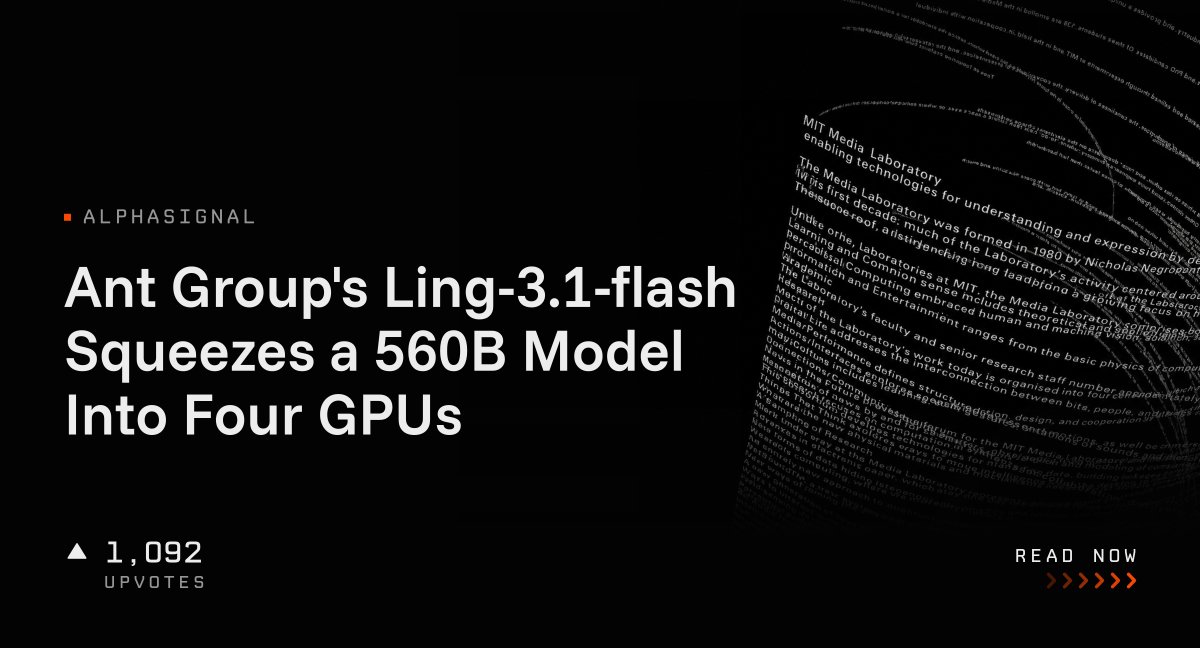
Ant Group’s InclusionAI lab has released Ling-3.1-flash under an open MIT license on Hugging Face. Powered by the BailingMoeV3 architecture, the mixture-of-experts model contains 560B total parameters while activating only 25B active parameters per token. The framework runs across 72 total layers structured in a 7:1 ratio, combining 63 KDA (Kimi Delta Attention) layers with 9 gated MLA (Multi-Head Latent Attention) layers. The network relies on 4 dense feed-forward layers, 1 shared expert, and 512 routed experts, dynamically selecting 8 routed experts for each token.
Memory optimizations make the massive model practical for enterprise infrastructure. By combining MXFP4 experts with block-FP8 dense layers, the developers reduced the overall footprint from 534GB to 292GB. This reduction allows 4-GPU Hopper serving setups to host the system efficiently. It accommodates sequence lengths up to a 1M token context window, with 262K served on gateways and a 32K max output. Memory demands stay manageable because KDA maintains a fixed state: conversations use about 0.5 GB of fixed state plus 10 KB per token, yielding approximately 10.5 GB cache overhead at the full 1M limit.
In terms of performance, Ling-3.1-flash scores 41 on the Artificial Analysis Intelligence Index while delivering throughput of ~210 output tokens/second. The release includes Day-0 support in SGLang and vLLM, utilizing MTP speculative decoding to accelerate inference execution.
For machine learning practitioners, this deployment recipe fundamentally changes the cost equation for operating frontier-scale models. By packing a 560B parameter open-weights model onto just four Hopper GPUs, organizations can achieve long-context inference and massive capacity without paying for multi-node enterprise server clusters.
This is our own summary of reporting by AlphaSignal