DeepSeek Releases V4.1 Flash Model with Web Search
DeepSeek has released its MIT-licensed V4.1 Flash agent model alongside general-availability Search and Fetch APIs, drastically cutting context costs for complex developer workflows.
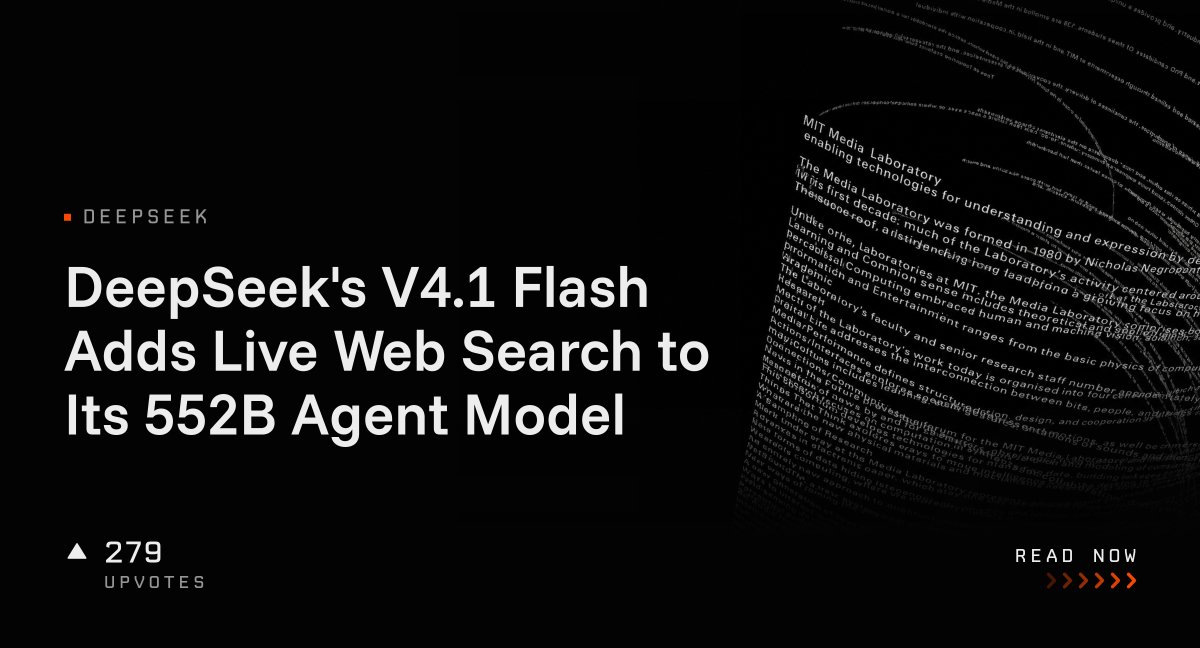
DeepSeek has released DeepSeek-V4.1-Flash-1017, an updated mixture-of-experts model optimized for multi-step agent workloads across coding, terminal, computer-use, and research tasks. Built on a 552 billion total parameter backbone, the model dynamically activates 8 billion parameters on input and 16 billion on output across a 1 million token context window. Hosted API pricing is set at $0.15 per million input tokens and $0.60 per million output tokens under the API identifier deepseek-flash. The open weights are available under an MIT license on Hugging Face and ModelScope.
The architecture features a 40-layer Causal Encoder-Decoder network using DeepSeekMoE feed-forward layers. The first two encoder layers utilize sliding-window attention, while subsequent layers rely on Compressed Sparse Attention 2. Key-value cache memory usage is reduced to roughly 25 percent of the previous Flash generation, addressing the GPU memory bottlenecks typically caused by long context loops. According to vendor reports, Flash outperforms V4 Pro in benchmark performance, generation speed, and overall task-completion time, benefiting from pretraining on image data for native image understanding and reinforcement learning with self-feedback.
Alongside the model refresh, DeepSeek launched public Search and Fetch APIs priced at $0.75 per 1,000 successful calls ($0.00075 each), with empty or failed calls excluded from billing. The Search API supports operators such as site:, -site:, lang:, after:, and before:, returning structured results with rerank_score values from 0 to 3 and authority tier ratings from 0 to 4. The Fetch endpoint converts web pages directly into Markdown for retrieval-augmented generation pipelines. Calls initiated through DeepSeek Harness, Claude Code, and Codex remain free until billing starts on October 31, 2026.
For developers building long-running autonomous agents, these combined releases lower both inference and context retention expenses while streamlining external web retrieval under a unified authentication system. However, practitioners should evaluate performance against the account-level rate limit of 5 requests per second (18,000 per hour), which may require careful orchestration for large parallel agent fleets.
This is our own summary of reporting by AlphaSignal