GOLLuM Framework Turns LLMs Into Scientific Optimizers
A new framework called GOLLuM trains large language models to act as reliable scientific optimizers, cutting the number of experiments needed to discover new materials and chemical reactions.
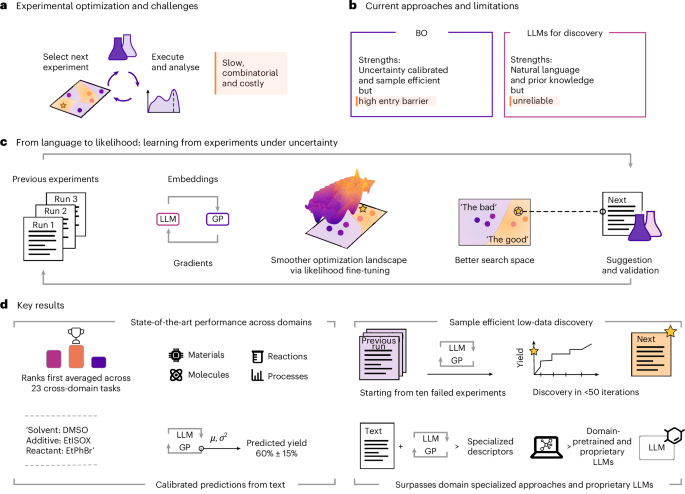
Researchers have introduced GOLLuM (Gaussian process Optimized LLMs), a new framework that trains large language models to serve as highly accurate experimental optimizers. By training a Google T5 encoder jointly with a Gaussian process surrogate model through its marginal likelihood, the system learns to organize its embedding space based on actual experimental outcomes rather than simple textual similarity. This approach effectively transforms the tendency of language models to hallucinate into a precise learning signal for scientific discovery.
Tested across 23 diverse tasks spanning organic synthesis, materials science, process chemistry, and molecular design, GOLLuM outperformed all competing methods. Starting with only 10 initial low-performing experiments, the PLLM phi variant of GOLLuM achieved a 36.3% top-5% coverage within a 50-experiment budget. This surpassed other LLM-based baselines like BoChemian at 26.5% and LAPEFT at 12.1%, as well as standard Bayesian optimization at 29.7%. Crucially, GOLLuM reached high-performing regions with a median of 41% fewer experimental iterations than traditional methods.
The framework demonstrated significant performance leaps in specific domains. In process chemistry, it achieved a 90% relative improvement, boosting top-5% coverage from 13.4% to 25.4%. In organic chemistry, coverage rose from 23.9% to 30.6%. For Buchwald–Hartwig reactions, GOLLuM achieved a 43% discovery rate of high-performing conditions, nearly doubling the 24% to 25% rates of state-of-the-art LLMs and outperforming specialized DRFP reaction fingerprints at 38%. It also improved mixed-variable tasks from 24.9% to 35.8% and numerical-only tasks from 24.6% to 33.3%.
For laboratory practitioners, GOLLuM removes the tedious requirement of engineering domain-specific descriptors for every new experiment. Instead of starting from scratch with custom molecular fingerprints, scientists can guide optimization using natural language. The model automatically clusters similar experimental outcomes, mapping out complex design spaces to reveal clear chemical patterns, such as identifying optimal solvent systems or isolating high-performing catalyst regions.
This is our own summary of reporting by Nature Machine Learning