Anthropic and OpenAI launch cheaper, more efficient models
Anthropic and OpenAI have released cheaper, faster versions of their flagship and mid-tier models, signaling a shift toward cost-efficiency as enterprises look to optimize their AI budgets.

Anthropic has launched Opus 5.5, the latest iteration of its primary mass-market model, while OpenAI has introduced GPT-6 Sol and Luna, two smaller models optimized for speed and efficiency. These releases mark a strategic pivot toward affordability as both companies compete with open-weight alternatives. Instead of chasing massive capability leaps, these updates target enterprise developers who are increasingly using model routers to bypass expensive frontier models in favor of more economical options.
Anthropic’s Opus 5.5 aims to reclaim ground from OpenAI’s recently released GPT-6 Astra, which had been modestly beating Opus 5 on benchmarks. The new Opus 5.5 performs slightly better than Astra at coding and knowledge work, but its primary advantage is cost. Input tokens are priced at $4 per million and output tokens at $20 per million, representing a 20 percent reduction from Opus 5. Cache reads, crucial for agentic workflows, have dropped 60 percent to $0.20 per million tokens. Additionally, the model generates text 30 percent faster and uses fewer tokens, bringing typical workload savings closer to 40 percent. For safety, requests in sensitive areas like biology and cybersecurity will carry the same protections as Fable 5.1, automatically routing flagged prompts to older models.
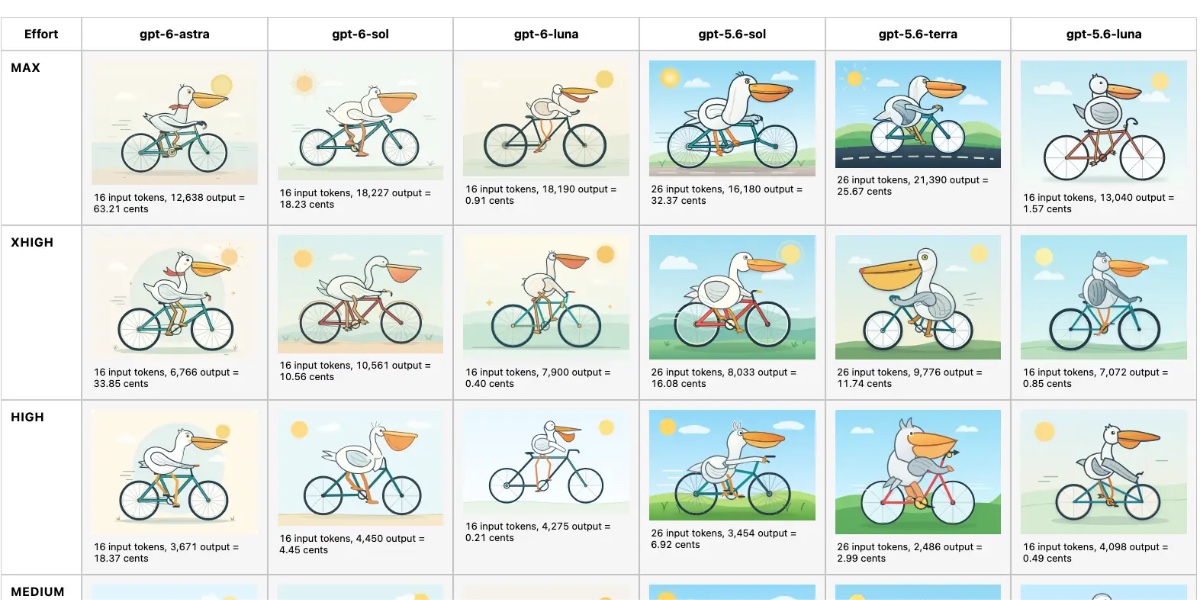
Meanwhile, OpenAI’s GPT-6 Sol and Luna offer an iterative, budget-friendly upgrade. These names follow a convention OpenAI previously introduced for its GPT-5.6 family. Within this hierarchy, Astra remains the premium powerhouse, Sol serves as the efficient daily driver, Terra handles general-use tasks, and Luna acts as the fast, low-cost option. Trained using methods similar to GPT-6 Astra, Sol and Luna perform a few percentage points better than their predecessors on benchmarks but cost half as much. GPT-6 Sol costs $2 per million input tokens and $10 per million output tokens, while Luna costs just $0.10 for inputs and $0.50 for outputs per million tokens.
For AI practitioners, this shift indicates that the industry is moving from raw performance hype to practical, on-the-ground operationalization. While the frontier continues to advance, developers are prioritizing predictable deployments and sustainable budgets over minor benchmark gains. These updates allow businesses to build sophisticated orchestration systems and agentic workflows without facing prohibitive API bills.
This is our own summary of reporting by Ars Technica AI