OpenAI Releases Proofs for 90 Open Math Problems
OpenAI published automated proofs for 90 major open mathematical problems on GitHub, signaling a shift toward AI-driven scientific discovery that both thrills and disrupts researchers.
OpenAI has published a repository containing 719 mathematical manuscripts across 372 problem families on GitHub, resolving 90 of the top 500 open problems listed in Proof of Atlas. Generated by an internal frontier model tested on roughly 4,000 problems, the solutions required an average of three hours of compute per result using mostly a single prompt. Three initial papers were withdrawn because they lacked formal Lean language verification, leaving 719 verified entries.
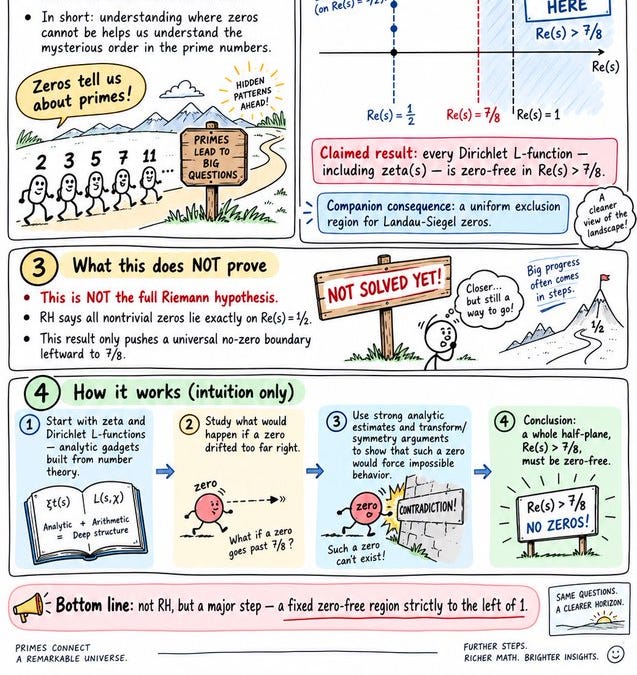
The automated output yielded major advances across theoretical computer science and pure mathematics. The model narrowed the zero-free strip for the Quasi-Riemann Hypothesis, solved Subhash Khot’s Unique Games Conjecture, and dropped the theoretical upper bound for matrix multiplication efficiency to an exponent of 2.25, surpassing the long-standing record of 2.37. It also generated novel proofs in quantum information, such as proving the area law in two dimensions, alongside asymptotic reductions in integer multiplication and new results on the Hadwiger graph coloring conjecture.
For practitioners and researchers, this sudden influx of solutions fundamentally shifts how research is conducted. Notable figures like mathematician Terence Tao expressed concern that automated solutions bypass human collaboration, leaving no co-authors to give talks, answer questions, or mentor graduate students whose thesis topics may vanish overnight. Meanwhile, cryptographers noted a complete absence of public-key cryptography proofs in the release, prompting leaders like Vitalik Buterin to advise increasing lattice parameter sizes tenfold to protect against unreleased AI breakthroughs.
This is our own summary of reporting by Don't Worry About the Vase