NVIDIA Debuts Nemotron 3.5 Super VL Agent Model
NVIDIA has launched Nemotron 3.5 Super VL, an open 120-billion-parameter multimodal agent model designed to streamline complex enterprise tasks into a single open weight checkpoint.
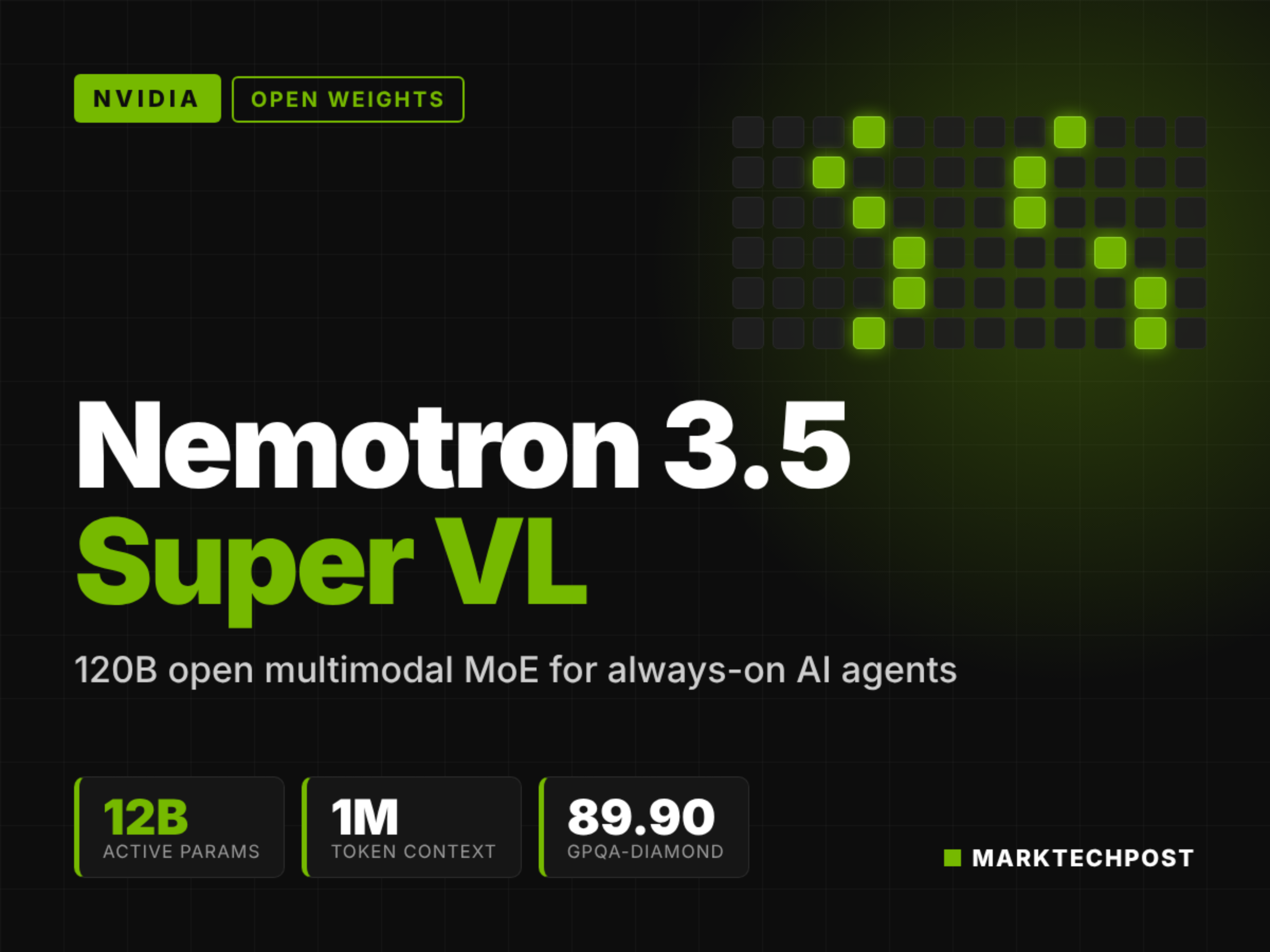
NVIDIA has released Nemotron 3.5 Super VL, an open vision-language model featuring 120 billion total parameters with a 12-billion-parameter active mixture-of-experts architecture. Operating across a context window of up to 1 million tokens, the model accepts text, image, document, and MP4 video inputs up to two minutes long. It unifies reasoning, tool calling, and code generation into a single open-weight checkpoint under the OpenMDW-1.1 license, replacing the traditional requirement to chain distinct text and vision systems together.
The architecture combines Mamba-2, attention layers, and mixture-of-experts layers containing 512 routed experts alongside a C-RADIO vision encoder. Distilled from Nemotron 3 Ultra, the model was pre-trained on roughly 26 trillion tokens, including 10 billion Indic tokens, followed by 3.8 million post-training samples. Running on hardware configurations like a single H200, GB200, DGX Spark, or two H100 GPUs using its 4-bit NVFP4 checkpoint, the system achieves over 600 output tokens per second on Baseten endpoints. Features like multi-token prediction, context prefix caching, and the LiLiCorr speculative drafter boost DGX Spark generation speeds by up to 2.3 times.
Benchmark evaluations reported by NVIDIA show strong capabilities, including 89.90 on GPQA-Diamond, 71.07 on SWE-bench Verified, 60.80 on Terminal-Bench 2.1, 77.5 on BrowseComp, 71.50 on IFBench, 79.88 on CharXiv reasoning, 62.82 on MMLongBench-Doc, and 52.3 on OSWorld-Verified. On agent harnesses, it recorded 63.44% on Hermes Bench and 87.05% on LangChain evals, outperforming Nemotron 3 Ultra despite using significantly fewer total parameters. However, it scored lower on long-horizon tasks, registering 17.78 on tau3-bench banking.
For developers, the model is available via Hugging Face, OpenRouter, ModelScope, and NVIDIA NIM, supporting runtimes like vLLM, TensorRT-LLM, llama.cpp, and SGLang. Alongside the main release, NVIDIA introduced two edge models: Nemotron 3.5 Bolt 74B-A9B, which uses 2-bit quantization to fit within 24GB of memory on RTX devices, and Bolt E4B, set for release on October 23. Early enterprise adopters report significant performance gains, including Scale AI recording 40-times lower inference costs and Ramp expecting up to 10-times lower latency.
This is our own summary of reporting by MarkTechPost