Vercel and Astro Replace Human PRs With AI Agents
Prominent open-source projects are blocking external pull requests to combat AI-generated spam, opting instead to use automated agent networks to resolve code issues.
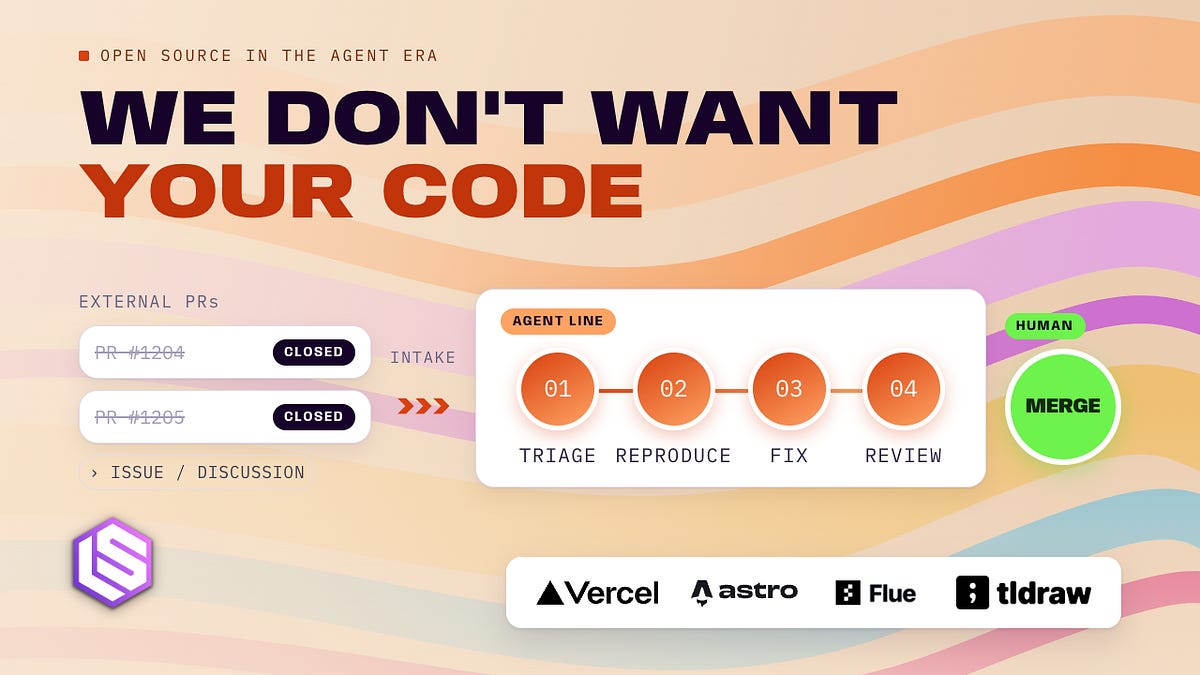
Open-source software maintenance is undergoing a structural shift as prominent AI-native projects begin rejecting external pull requests entirely. Faced with an influx of low-quality, AI-generated contributions, projects like Vercel's AI SDK, the Astro web framework, Flue, and tldraw are replacing traditional community contributions with automated software factories. These systems deploy specialized teams of AI agents to triage issues, reproduce bugs, write fixes, and conduct initial code reviews before handing the final product to a human maintainer.
Vercel implemented this approach for its AI SDK, which receives more than 20 million npm downloads weekly. By late June, the project's backlog had swelled to over 1,000 open issues and nearly 800 pull requests. To regain control, Vercel built a custom system utilizing distinct agents for specific tasks, such as bug reproduction and code patching. Just four weeks after deploying this software factory, Vercel reported that its automated agents now author between 25% and 35% of all merged pull requests and successfully close 70% to 80% of open issues.
Other major projects are adopting similar strategies to handle overwhelming backlogs. The Astro web framework, which boasts 62,000 GitHub stars, has integrated automated triage to manage incoming reports. Astro creator Fred Schott subsequently launched Flue, a new agent framework that automatically closes external pull requests and converts them into issues or discussions. Similarly, the React-based drawing tool tldraw, which has 50,000 GitHub stars, has blocked external pull requests since January. Its creator, Steve Ruiz, noted that accepting external code makes little sense when internal agents can write the necessary fixes.
This shift fundamentally alters how developers interact with open-source repositories. Instead of submitting direct code fixes, contributors are being redirected to focus on discussions, bug reporting, and feature design. While some industry figures, like Superlogical co-founder Mitchell Hashimoto, predict that large open-source projects will eventually close external contributions entirely, others emphasize that human collaboration will simply shift. By offloading coding tasks to trusted, internally optimized agents, maintainers can dedicate their time to high-level architecture and community building.
This is our own summary of reporting by Latent Space


