Hugging Face LeRobot Standardizes Open Robot Learning
Hugging Face's open-source LeRobot library is unifying the fragmented robotics landscape by establishing a standardized protocol for datasets, training loops, and hardware drivers.
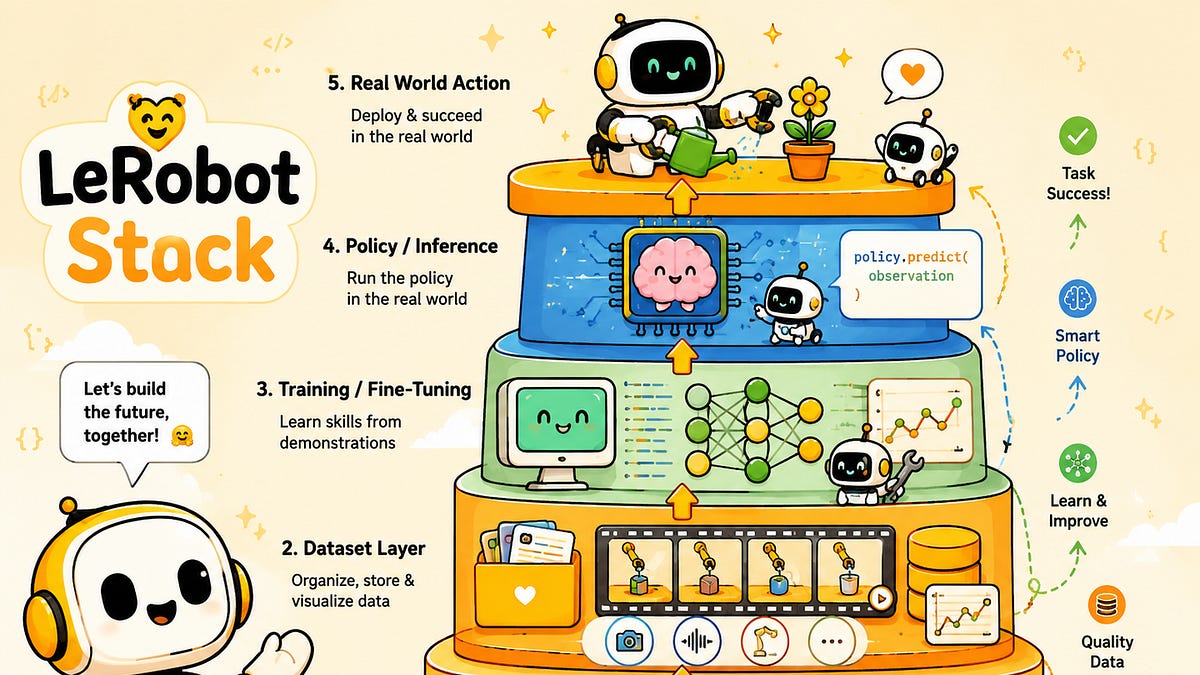
For years, the field of robot learning struggled not from a lack of capable models, but from extreme fragmentation across research labs. While architectures like Action Chunking with Transformers (ACT) and Diffusion Policy demonstrated strong capabilities, developers were constantly bogged down by incompatible dataset formats, custom teleoperation rigs, and bespoke training loops written under tight deadlines. Hugging Face has addressed this coordination bottleneck with LeRobot, an open-source library designed to serve as a unified protocol for the entire robotics stack.
LeRobot has rapidly transitioned from a promising repository into the default substrate for open robot learning. The project is now backed by an ICLR 2026 paper and features significant contributions from industry heavyweight NVIDIA, which has integrated its GR00T humanoid robot foundation model and Isaac Teleop platform into the ecosystem. By providing a standardized middleware layer, LeRobot aims to do for robotics what Hugging Face's Transformers library did for natural language processing and Diffusers did for image generation.
For robotics practitioners, this shift eliminates the tedious requirement of writing custom hardware drivers or maintaining incompatible data pipelines for every new experiment. Instead of rebuilding foundational infrastructure from scratch, developers can now leverage a shared ecosystem where models, datasets, and physical hardware configurations compose seamlessly. This standardization allows researchers to focus on scaling and refining physical AI behaviors, accelerating the transition of robotics from isolated academic papers into a cohesive, production-ready technology stack. By simplifying the onboarding process, LeRobot lowers the barrier to entry for software engineers entering the physical AI space.
This is our own summary of reporting by The Sequence